
A quick look on eBay will reveal thousands of low use, high quality film cameras for incredibly low prices. It is perhaps the best time ever to buy a film camera, but why would you want to go back to film when today’s digital cameras produce such stunning images. Well, here are some reasons.
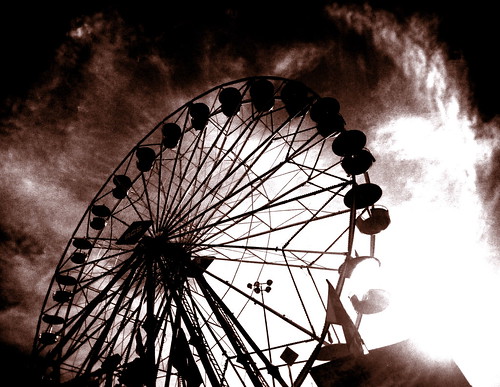
by kevin dooley, on Flickr
The Look of Film.
Many photographers today spend huge amounts of camera time and post processing time to try and recreate the film look. There is a definite and pleasing look to the quality of film, it’s impossible to describe with mere words and it’s not necessarily a better look than digital, its just different. So the easiest way to create the film look? Use a film camera.
The Feel of Film
Maybe it sounds a little crazy, but those of us brought up in the days of Kodak, Fuji, Agfa and Ilford will tell you there is something very special about putting your hands into your pocket and pulling out a roll of film. Placing the leader of a roll of 35mm into a Nikon, unwrapping a roll of 120, whilst trying not to expose too much of the film to light, simple skills that marked you as a photographer.
The Cost
It might seem odd that I include the cost as a reason to return to film but bear with me on this one. Every time you put a roll of film in your camera, it has cost you money. That cost continues with the development and printing. Every time you take a poor picture, it has cost you, personally. But the counterpoint to that is that every time you a good picture, you will appreciate the value of your knowledge of photography. It’s too easy these days to rely on the camera to create the image. Delete the poor ones keep the good ones. When you have to pay for each image, you will learn to make each one count, and that will stand you in good stead when you return to your DSLR.

Learning to Understand Exposure.
The previous reason, leads us onto learning exposure. Although film is generally regarded to have a higher tonal range than digital, is has a lower tolerance to incorrect exposure, especially if you are using transparency. An underexposed image cannot be recovered by merely shifting the levels, it needs to be right when the shutter clicks and you need to understand what is happening when the exposure is made.
Understanding Color Temperature
Unlike a digital camera where you can set a color balance or let the camera do it automatically, you have to buy the right type of film for the right type of light. The first time you use a roll of daylight film under tungsten lighting, you will start to understand the importance of the color of light.
Pro Cameras at Low Prices
For many of us former film users, cameras like Nikon F5’s, Hasselblads, even Leica’s, were the stuff of dreams. They idea of one day owning one of these marvels of imaging fueled our passion for photography. Take a quick trawl through eBay today, and you will find mint quality samples of these cameras for less than the price of a base level DSLR.
Do it Yourself
For aficionados of the digital darkroom this may sound odd, but getting your hands dirty by developing and printing your own films is in my personal opinion, one of the great highlights of film photography. Its easy enough to make a temporary darkroom in not much more space than it you would need for a desktop computer and A3 printer. The sight of a large black and white print, slowly revealing itself under the gloom of a red safe light should thrill even the most hardened digital darkroom enthusiast.
So there you have it, if you have a hankering for trying out film, there are little or no obstacles. Trawl through eBay, or your local camera store, bag yourself a bargain. Most professional camera stores still sell film and will also know where you can get it developed and printed. If at the end of the day you still prefer digital, old film cameras make great ornaments for your home.
Jason Row is a British photographer based in Ukraine. Follow him on Facebook or see his work at The Odessa Files.


46 Comments
I have another reason! People won’t just expect you to hand over the negatives when it is film, and will be happy to pay for prints.
Good points, but I have one big disadvantage to film–getting through airports!! They hand check every roll, unless you want to send it thru the scanner(not recommended for faster films). Painstaking, and time consuming.
I haven’t tried this…I honestly can’t stand to fly but I’ve read that if you take the film cassette out of the container and put them in a clear plastic bag that your inspection will not take as long. I haven’t tried it..but I’ve read that it works.
I was glad to see this — I’ve been considering trying out film, if only to force myself to really learn photography, and stop relying on my digital camera as a crutch. Could anyone suggest a good camera model to prowl for on eBay?
Hi Eileen, have a look for a Nikon F100. It was perhaps the pinnacle of film camera technology, set just below the Nikon F5 professional camera. Think Nikon D700 to the Nikon D3. It has good autofocus, and auto exposure but also a full set of manual controls to help you expand your knowledge.
You should get a decent model for $150-200
the cost is the big one… and the need to learn camera craft so each press of the shutter counts
I love film. It makes me think so much more about what I’m actually shooting (which is now transferring to when I use my DSLR). And when you get it right it is so satisfying!
Something else to add to the list… If you hate dust on you monitor, just wait ’til you start scanning and enlarging your own negatives. It’s a nightmare!
https://farm6.static.flickr.com/5096/5456720821_9660135b5f.jpg
Bigger:
https://flic.kr/p/9jc7Zt
My wife, also a photographer, is amazed by the fact that I can tell her what the exposure should be just by knowing the ISO of her camera. No meters, just a mk1 (old model) eyeball. Thats the sort of experience that comes with using film
Hey Jason, very good article and picks up on everything I tell people who come up to me asking for advice on taking up photography. I always tell them to pick up a 2nd/3rd hand film camera. Take out the battery and learn to shoot using your ‘eyes’ and not meters. The other advantage of film, is I set projects and that keeps my eye in as I spend the time composing the shot, as it needs to be right. Film thru customs not a problem as I do not use hi-speed film, but miss my dark-room at the moment. Working a dark-room is good fun and allows for just as much creativity.
I would love to return to using film as I find it way more rewarding, but it’s so hard to find the time!
Luke, one can always find the time for their passion 😉 Do it, you know you really wanna … Kudos
Uncanny timing, this post. I’ve just returned from a trip to NYC. When I booked the flight a couple of months ago I also decided I was going to take my old Leica CL film camera (fully manual focus and exposure) and just a digi compact. I found film suppliers were easiest to find online (the high street shops didn’t have any in stock) and choice was limited compared to the ‘old’ days. Just got back, so the next step is processing and getting the negs printed and scanned (I don’t have a darkroom any more so a lab it has to be). Again, this is being done mail order and the final cost is going to be quite high with 13 rolls in need of attention (postage, processing, printing and scanning).
The first day of using the camera felt odd – not being able to simply adjust the ISO when it got darker, no instant preview of the image, just three prime lenses and no zoom. But once old ways of shooting came back to me I remembered why I decided to bring the film camera – it slowed me down, made me think more about what I was shooting, made me think about how I was shooting the photos etc
An enjoyable experience overall and I’m looking forward to seeing the photos. The cost of film and processing has mounted up though and I now can’t wait to see the pictures!!!
i am very happy to read an article like this one. i am a professional photographer loosing interest in photography because of digital.
all the photographers should have some good old analog camera and go back to the roots from time to time…
https://www.flickr.com/photos/matabum/4468034412/
I am a professional photographer and I cut my teeth on shooting film. But except for the discipline film imposes on you to keep shot quantity down, all the reasons you mention to shoot film are really reasons to avoid shooting film. With the instant feedback of digital, you can learn the principles of photography much more efectively.
Couldn’t agree more. I don’t miss dust, scratches and lab / post delays or late nights coming home smelling of chemicals. I’m glad I learned on film because it created discipline to value frame count, but the greatest liberator is being freed from carrying multiple rolls of different ISO films to different conditions.
John I used to be in a photography club and most of them wouldn’t try to take an image or thought they couldn’t take an image without P on their dial and IS in their lenses. They won’t trust an image that they take because after each shot they are always checking the back of the camera. I’m not a professional but a very dedicated hobbyist but I’ve gone back to shooting film about 80% of the time. The new Cinistill films and the Lomography 800 are just awesome!
I remember the all nighters in b & w darkroom. Yes, an exciting experience but also a time consuming hassle. All the reasons this author has listed remind me of why I’m so happy to have digital. He forgot to mention the polaroid effect of instant review.
What’s all this BS about needing a darkroom for DIY B&W film processing? All that’s needed is a film changing tent or bag to transfer the film into the developing tank. The rest of the process, including printing, can be performed in broad daylight: Put the film into the tank. Develop it. Scan the negatives. If necessary, work the images in Photoshop. Print on an inkjet printer. …Not too difficult.
I’ve given up on film. Anyone interested in some fine film cameras, send me a note. For example, I have a Nikon F4s in great shape and will sell it fi $225.
Write to [email protected]
I did love to spend time in the darkroom on bw processing, it was like meditation and occasionally I want back. And I have so many tenthousends of diases/slides on landscape
But I realy startet to learn something when I finally got over to a good digital camera.
I’ve just returned to film and believe it helps you to see more creatively. I’ve written about this on my blog, The Online Darkroom. The post is at:
I’d be really interested to know if other photographers have noticed this internal v external visualisation thing. If you have, please leave a comment after the post.
The amount of skills developped during film photography, the every-day excitement of waiting to see the results, as film rolls are being processed, the attention to detail while setting up a frame, hiding cables, the Polaroids, the meticulous use of the flash metre and above all, the work spent on lighting to capture that single shot, complete and ready to be scanned and used in a layout straight away, really puts digital photography in a different category with less excitment and results that could be digitally manipulated in post, but not for the professional eyes.
Another valid reason to shoot film is another way at looking at cost. Film offers a much higher dynamic range, that is the steps from the purest white to the darkest black defined by various zone systems.
Film has been fine tuned over the years to yield 11 or more stops, while most digital cameras can only cover four.
What does this have to do with cost ? Well in order to get a DSLR capable of the same quality you at least have to go full frame if not medium format at 10 to 35 thousand dollars. A lot more than the cost of a few rolls of film.
So if you are ever wondering why some of the images you love so much have such rich colour and seem to jump right off of your computer screen, quite often it is because they are shot with equipment that can cover the range in camera. All of the Photoshop tricks and HDR technique in the world cannot take your raw capture to that level, but film can.
All great points that I preach often. Understanding lighting and exposure, appreciating each shot, acquiring the need to improve at each failed exposure, learning from your mistakes, etc. In my opinion, the real jewel is learning the components that make up a good shot. The individual aspects that are often overlooked, or easily corrected by DSLR’s.
Great article. Now I just hope film won’t die out like Polaroid’s did 🙁
Considering how vinyl records are making a comeback, we can only hope film decides to stick around as well.
Every shot, every frame, every second of waiting is a good reason.
I like to comment this. Every shot done is a very serious lesson to photographer. About 5 days ago, I used EB3 for a small test. Using F/4.5, 1/125 with 80-200 MM LENS.
The result is very strange,Nearly Black due to forest’s effects. I shall use a slower shutter for the EB3 or using F/8 to test it out.
This was very horrible since something is not expected like Colorplus (C-41 processed Film), Luckily the content is not so important and some of the result is good
However, the low-cost age for the E-6 may be gone, Then You seldom know how to do good.
For some reasons, I use a scanner to scan some of good results, and the remain is a lesson.
Film photography is cheaper not because of said above, but because the poor digital guys have to buy a brand new camera every other day (and still can never say they have had the best camera), while I already have the best film camera ever built in history of mankind: likes of Nikon F6, Leica MP, Hasselblad 501CM, etc.
I agree completely with all your points. People who aren’t willing to get their hands wet in the dark don’t really know photography.
Started in Film, moved to video and digital, came back to Film for my own projects (non commercial) and loving it !
Another thing to add:
Film cameras can be collectors items,
can you show me one person who would buy a Nikon coolpix because it’s a beautiful camera ?
cheers
I have an old Nikon D1 and I bet it’s more beautiful than any of your antique film cameras.
…Ever used a Nikon f4, Nikon F2, or any Leica M?
All I have to say is AMEN! Thanks for the post. I’m about 80% film now.
Shot film (and developed and printed it myself in many cases) for decades. Lovely work has been and continues to be created with film. I understand the retro appeal of old-school film and enjoy the tactile quality of the wonderful older cameras.
That said, I have absolutely no desire whatsoever to return to using film.
I have far greater technical and expressive control over my photography with digital media, and I can produce work that is at least as good and often better.
An important point. Even at the lowly 35mm format, with pro low iso transparency film, and a state of the art wet scan (with a salty technician), you can achieve a 500 Meg+ scan at 48 bit color depth. If you want a better print at a huge size, you better have a pretty fancy digital back on a medium to large format, likely darn close to six figures or more.
Interesting article and replies, I am 73 so have done a lot of film work since about 1960, been digital for some time, several camera including the venerable but expensive M9, a few months ago I dug out my NIkon F80 and put a film in it(XP2) and took some pictures, I did not use again till last week and had forgotten what I photographed, exciting! I had the XP2 developed, I scanned the negatives and I am knocked out with the results, great dynamic range and the range of greys is stunning, it now has a roll of HP5 loaded, I sold all my darkroom equipment to a photography student but had the sense to keep my film developing tanks etc(stainless Steel)Off O go!
It’s nearly 50 years since I started making photographs seriously as a kid in high school. After that, I used the medium of film for most of my career in magazine production and public relations. Back then it was transparencies and B&W prints destined for publication and agency representation when there was actually money in it — and a fairly high bar of excellence you had to reach before acceptance. But the writing was on the wall. I dropped film entirely 8 years ago for digital, and actually learned it rather well, continuing to publish stock images and use others in my work. Problem is that sales don’t amount to much anymore as so many “weekend warriors” burning 1000’s of shots for a few “keepers” are willing to sell them for a buck or two — or even give them away — just to see their byline and gain the dubious title of “semi-pro.” But last year, I had sort of an epiphany… realizing that with digital I was constantly chasing the next best camera and sensor, led by the nose by Nikon and the rest into a silly consumerism that did not exist so much with film. Pro DSLRs do amazing things, and usually as good or better than the best of the film cameras of only a decade ago. But with them the rhetoric of photography has transformed into continual bantering about silly “hipster” concerns like “bokeh” that is definitely not the key to excellent photography. Combine that with the barrage of chats about sensor and lens quality, chromatic abberations, raw vs. jpeg that are quite meaningless in terms of the art of photography, of the image as a whole and its emotional effect on the viewer. Given that, it still surprises me how many people today (the younger set, I believe) think that film images are crappy, manual focus lenses without the hyped up latest and greatest nano coatings are not sharp, and film is so hard to process and scan. Indeed, with a number of mail-order processors out there you don’t need a wet darkroom to enjoy film, though I recommend processing B&W materials yourself to save money, time and get much better results. So I bought a nice old Nikon F3 and had it reconditioned to mint by Nikon. And acquired a gaggle of Nikkor lenses from 24mm through 200mm. Some developing tanks and a scanner topped off the gear, with a stock of B&W film of different speeds and brands to get reacquainted. Off I went, to the bold old world of film. And guess what? I had more fun with photography than I had for at least the 8 years I fiddled with digital cameras. Lightweight, well-crafter cameras! Beautifully machined, reliable, “built like a tank,” smooth as silk manual focus that is right on the mark. And premium glass every bit as sharp and sharper than modern, complex, unreliable and expensive pro zoom lenses for a quarter of the cost! Best of all, no chimping…. no more continually checking your result. Instead, it was back to relying on my knowledge, skill and experience to conjure the best exposure and processing for particular light and contrast ranges. I truly enjoy photography again, and hardly think of picking up my digital equipment except for an occasional job where color and digital delivery is expected and therefore “necessary.” I am not disparaging digital. Far from it. Digital is the “Now” and even more so the “Future” as capture and delivery technologies expand beyond our imaginations in a very short time. But shooting film provides another experience in photography that cannot be matched by digital cameras. B&W only costs around15 cents per shot for film, processing and scanned to your computer screen. After you get the cost per shot nuisance out of your head, you realize that film shooting requires a different approach to the subject, that is not necessarily slower, but certainly includes more critical considerations of light and contrast that few digital photographers care about. Why? Because they know they will “enhance” their images later in Photoshop (read: overprocess, HDR to death, oversaturate). The only way to share the experience is to shoot film, learn film, love film. Love digital, too, but please don’t disparage film and call for its death.https://www.artcomphoto.com/picture/coal%20virginia%20clinchfield%20mcclure%201%20woman%20miner%202.jpg?pictureId=3309379&asThumbnail=true
There are many good reasons for using both mediums. Personally I have been shooting film for the three agencies requesting images. Most of my work is 35mm for Socio/Cultural work and medium format or larger for landscapes and scenic. I can’t tell you how much I love and enjoy film photography, and those speaking of the ease of use, being able t see the image now and doing post-production on the computer – if I want to ‘tweek’ any image, I have all my work put on a disc at time of development. I can change or alter whatever I want on my computer later. There is something special about film that digital can’t come near to. It just has a certain feel to it. But I do like using my digital, especially for family use and sometimes for travel photo work. I am glad film is s!till available. Hollywood still uses it for their work and then just transfers it for digital expressions later. Film will not be going away as it is still widely needed and used commercially and in Hollywood.
Excellent points. What I have found is the lack of self discipline with digital. We were taught to shoot two of each picture we took, just in case. The expectation was, of course, to do it right the first time. With digital we get lax and sloppy, shooting without proper planning or thinking. Come time for editing, well, that’s a whole other story with how many hundreds of pictures!! It is film or treating your camera like a film camera that will make you stop and pay attention to the rules and fine points of photography as well as what your camera needs from you, thereby achieving a far better ‘product’.
Very nice piece. I am a huge fan of film, always have been. I love the entire FILM experience. Currently own and use these film cameras:
Nikon F6
Nikon F5
Nikon F100
Nikon F3
Nikon F2
Get out and shoot some film!!
I’m having tons of fun with a Holga. It was dirt cheap, maybe someday I’ll upgrade to a more serious film camera…but not today 😉
I thought I’d have to read a book for a divcesory like this!
I was looking at the price of 8X10 digital fine paper, wow $5+ a sheet, About twice as expensive as silver enlarging paper. I’ll never give up the smell of fixer!
I am always looking for something to read about shooting film. This thread was a great read. Thank you. No youngster am I. I always loved cameras, although, as a kid, I was very ignorant of the photographic process. I was just a consumer. I grew up in a very modest household where Mom was the photographer. I remember her shooting on a twin lens reflex camera, then came the Polaroids. She shot many photographs, and I picked up the interest from her. As a 9-year old, I shot with some plastic fixed lens roll film camera, then graduated to a Kodak instamatic, and, finally, to a Polaroid camera of the mid-1960’s, pre SX, had a “magic eye” that metered the scene.
I was in college when I bought my first 35mm camera, a Yashica. When I go back and look at those photos, I am still amazed at how good they were. That camera infected me with the bug that has ravaged my existence to this day. I’m not certain why I never looked to Nikon or Canon, but wound up going the Minolta route instead. The camera I loved the most was my X700. Silky smooth shutter, some sort of integrated flash, auto-exposure, but, looking back, modest in terms of its features. Next came a Maxxum 9000 (the last camera I would ever have to buy). In reality, that camera was the last film camera I ever purchased at retail. It served my needs from the date I purchased it back in 1985 until I purchased my first digital camera (Sony A100) in 2006. In the late ’90’s, my 9000 developed LCD bleed on the panel inside the mode dial on top of the camera. This was caused by my careless packing of the camera that exposed it to some severe vibration. At the time, I thought nothing of it. Just go to a camera shop and arrange to have the issue repaired. To my amazement, no repair was offered. I was shocked, stunned, my Minolta loyalty somewhat shattered. Since the issue was purely cosmetic, I determined to live with this defect, but continually browsed the mail order section of photo magazines to see what was available to replace my trusty old friend.
That browsing proved to me the value of the investment I had made in the 9000 so many years prior, as it held its value quite well. The top of the line Minolta at the time was the Maxxum 9. I really wanted that camera, but it was really expensive, much more than I had paid for my trusty 9000.
I had always preferred to shoot slides, but my better half always wanted prints. As the digital age came upon us, I was one of the early adopters of scanning both negatives and slides, and this led me to discover Photoshop as it was developed. Eventually, I acquired the A100 digital SLR (I held off on earlier cams as I felt their resolution too low).
Today, I am the very pleased owner of two of those Maxxum 9’s for which I lusted, one a Maxxum, the other an Alpha (marketed in Japan). I shoot digital on a Sony A700 for work-related issues, film for my personal and family photos. I love my a700 because it most resembles the film SLRs I so enjoyed. It is unbeatable in situations where you need to adjust for changing lighting (low vs high, outdoor vs indoor vs mixed), it has been a great tool in expanding my knowledge and confidence in those areas where, with film, I had none. I had, for my 9000, Minolta’s top of the line AF4000 flash, but would never have experimented with bounce flash back in the day. Digital allowed me the luxury of free experimentation and instant feedback such that I have developed and am confident in my use of bounce flash, light modifiers, multiple off-camera flashes, etc., and I use the knowledge derived from my digital experience to enhance photos I take on film. Sometimes, I use my A700 to determine my settings for a shot that I want to record on film . . . works like a charm.
Film will always possess a certain mystical quality for me. I remain amazed at the quality of some of the shots I took with my original Yashica, and the shots were so good because the camera and lens, while basic, were both solid in their ability to capture beautiful images when treated to a very well developed film capture system. Those films have survived in surprisingly good condition even though they have not been stored in the best of environments.
I have digital images that are no longer viewable because the media upon which they were stored is no longer accessible (crashed drives).
I know it really has nothing to do with the art of photography, but I am in love with my recently (relatively speaking) purchased SLR cameras, and I am ever dazzled by the wonderfully satisfying surprise that envelops me when I get a set of negatives back from the processor.
Digital is absolutely amazing, and I love that camera, also. But, film will always be my favorite medium. Thanks to all who have contributed for a stimulating thread. Happy shooting.
Caruso
wish I could edit the above. Should be “I know it really has nothing to do with the art of photography”. Please excuse the error.
Thanks.
Caruso
We have updated it for you 🙂